

Complex Project Governance
Your project's biggest risks
are not on your risk register
Find the sources of avoidable failure while there's still time to act.
Failing to manage risk interactions
is your biggest risk
✅ The governance pack is complete.
✅ The schedule and risk register are up to date.
✅ The steering committee has met, and most indicators are green or amber.
But, if you could hear the conversations happening across the project, would they tell the same story?
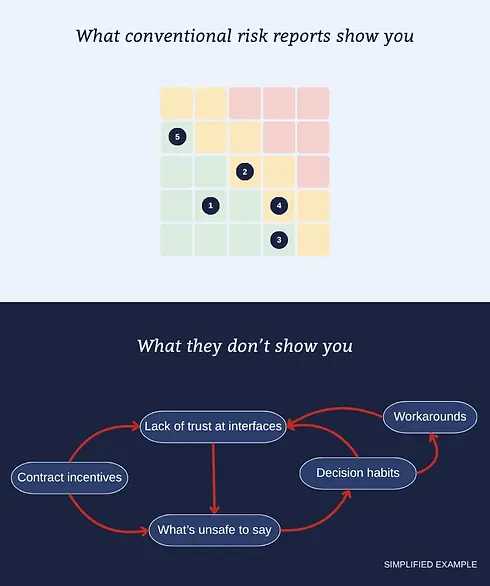
Conventional risk management fails Project Managers and boards so often because it is:
-
built to assess and treat risks individually
-
biased towards tangible and easier to quantify risks
But the risks that most often blindside boards and cause project failure are:
-
internally generated, intangible, and dynamic
-
scattered across teams and functions
-
too politically sensitive to report
These risks propagate through relationships, cross boundaries, and create reinforcing feedback loops that drive 'creeping crises' in throughout your project.
The earlier you see trouble brewing, the more options you have
SRGO
Systemic Risk Governance Oversight (SRGO) by RiskIQ monitors systemic and emerging risks across your project and provides PMOs and Boards:
-
unfiltered visibility
-
early warning
-
root causes
- priority actions to take
This gives you
-
more time to act
-
more optionality
-
more cost-effective interventions

SRGO doesn't replace your existing systems, it enhances them.
You don't need yet another function added to your org chart. Nor do you need to disrupt your existing project management systems or operations.
SRGO is specifically designed to be an independent, ongoing, governance capability that sits alongside Project Management Offices and existing governance structures.
The 5-point method includes:
-
Independent Oversight: RiskIQ acts as your expert, trusted third party monitoring the system to find risks internal teams are too close to (or too fearful) to report.
-
Low-Impact Data Gathering: Information is drawn from existing data and tailored, brief stakeholder interviews.
-
Systemic Risk Analysis: Using RiskIQ's Systemic Risk Analysis (SRA) to connect fragmented evidence, find hidden patterns and root causes.
-
Direct Reporting: Providing the Board or Steering Committee with an unfiltered view of the project’s true health.
-
Efficiency: Focusing on inquiry over administrative box-ticking reduces red-tape.

What to expect when you integrate your PMO with SRGO
Sense Conditions
-
Confusion and decision latency
-
Misaligned incentives and resourcing
-
Conflicting agendas and assumptions
Find Relationships
-
Hidden risk interactions
-
Feedback loops and knock-on effects
-
Masking of capability and governance issues
Improve Outcomes
-
Prioritise leverage points for intervention
-
Increase assurance and reduce red-tape
-
Reduce drift and avoidable failures
We probably already train your competition.
RiskIQ's approach to systemic risk is taught at both:
The International Centre for Complex Project Management (ICCPM)
The international Peak Body of excellence in complex project leadership
+
Queensland University of Technology's (QUT) Executive Masters of Complex Project Management (EMCPM) program.

